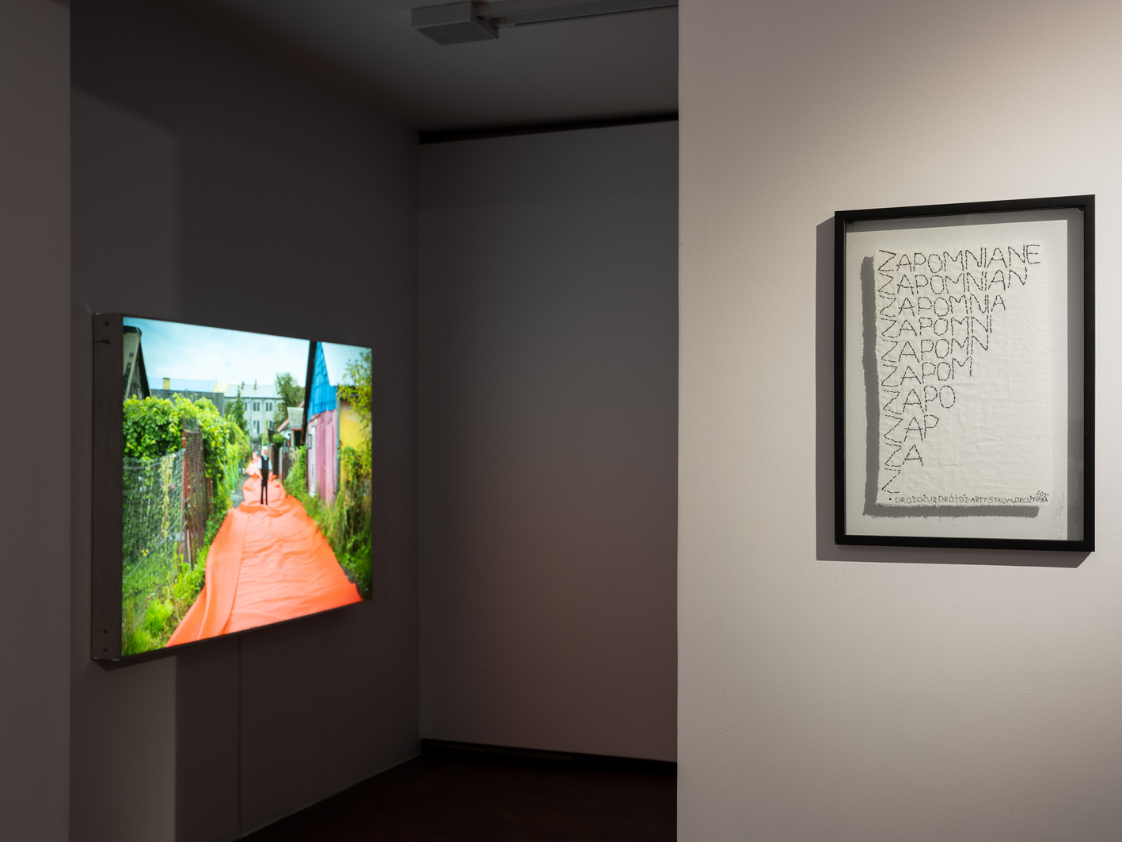
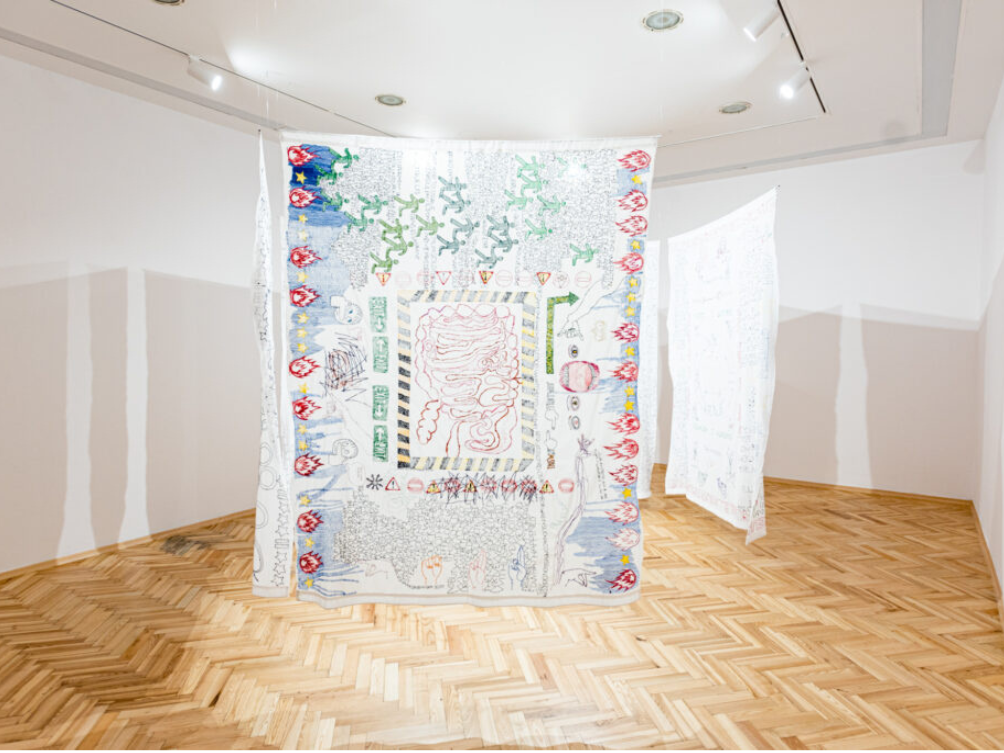
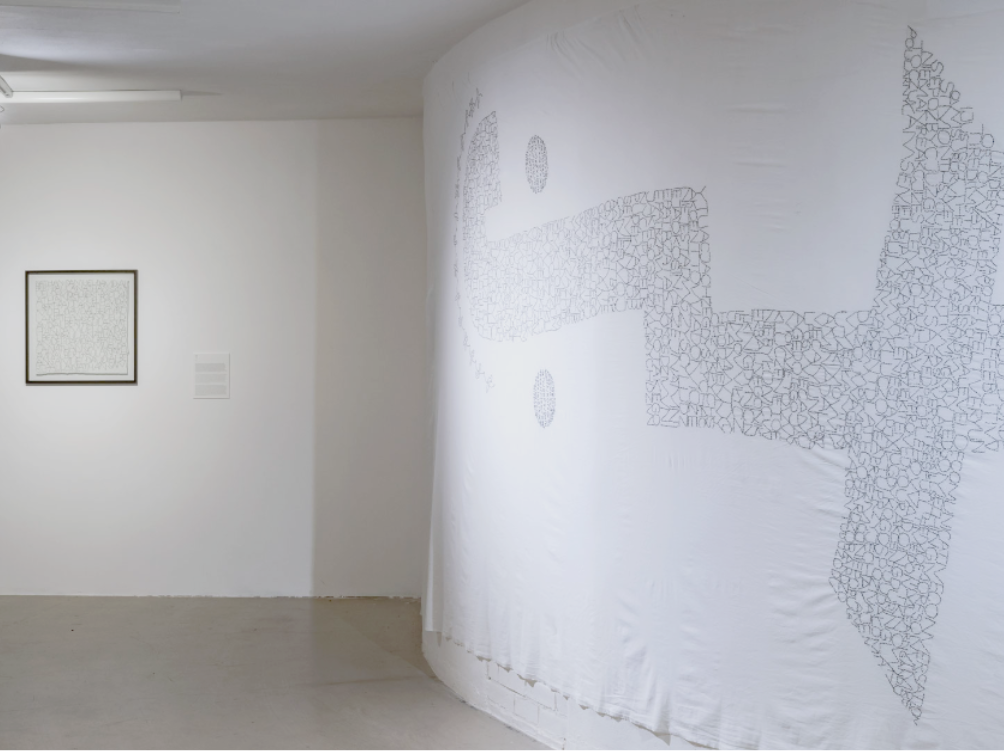
24,20. Exhibition of the series Embroidery in Transit, 2015-2025
Common Arts Foundation
Curator: Iwona Wojnarowicz, photo: Szymon Sokołowski
Spanning a decade, Monika Drożyńska’s Embroidery in Transit project ran from 2015 to its completion on February 14, 2025. Over those ten years, during her numerous travels across Poland, the artist embroidered headrests on PKP trains to provoke reflection among passengers of the state-owned railway. Drożyńska describes her “headrests” as follows: “The themes of my works cover issues such as women’s rights and include quotes from poetry and literature, as well as my texts. I embroider, among others, Tuwim, Białoszewski, Janion, Tokarczuk, and Bator. I leave the finished embroideries on trains and airplanes for other travelers. Sometimes, I receive messages from passengers saying that my embroidery keeps them company during their journey. My works always provoke strong emotions — from admiration and sympathy to outrage and criticism”.
In May 2024, PKP Intercity S.A.’s Central Branch in Warsaw accused Monika Drożyńska of “damaging 58 headrest covers by embroidering on them, causing losses amounting to 510.04 PLN”. In August, under summary proceedings (without a trial, based on testimony and evidence), the court found her guilty of the charges and “imposed a reprimand and an obligation to pay compensation equal to the damage to the injured party”. While the artist admitted to creating the embroideries, she refused to plead guilty to the charges. She appealed the verdict, seeking a full trial to ignite a public discussion about art. Thus, the legal proceeding became a post-artistic action.
On February 14, 2025, the District Court for Warsaw Praga-South, Criminal Division III, convicted Monika Drożyńska for embroidering on headrests in PKP Intercity S.A. trains. She was reprimanded and required to pay damages.In total, 58 embroideries were documented, which served as the basis for the indictment. Ultimately, the court confirmed three of these works as evidence and sentenced the artist to pay compensation of 24.20 PLN to PKP. Monika Drożyńska’s art was thereby given an exact legal valuation.
The court acknowledged the embroideries’ artistic value but ruled that they infringed upon the railway’s property rights. The judge stressed that “artistry does not override illegality,” meaning that artistic merit does not justify the infringement of private property. As a result, Monika Drożyńska became the third artist to be convicted by a Polish court for her creative work. She is also the first to be sentenced on capitalist grounds — placing the private property of a state-owned company above artistic freedom and social engagement. Her actions were deemed harmful, leading from accusation to final verdict.
The conclusion of the project thus marks the beginning of a reflection on the “headrests”. Drożyńska’s activist stance in public space and the judicial response to her work have reopened the debate on the limits of artistic freedom and the boundaries between the public and the private.If something is private, whose property is it? Where does artistic freedom end and private ownership begin? What does private ownership mean in a public space that belongs to everyone? On what basis do we decide what is allowed and forbidden in shared space? Who gets to determine whether an act is art or vandalism? Is aesthetic value — so individually perceived — a sufficient criterion to define what art is? And if so, who gets to decide?These questions are not new — but in the age of late capitalism, they demand to be asked again, and out loud. The 24.20 exhibition does not offer answers. However, we hope the questions will resonate once more.
From April 12 to August 30, in Warsaw’s Wola district, it will be possible to see 58 “PKP headrests” — a series of works that summarise and conclude the Embroidery in Transit project, 2015–2025 — as well as a documentary film about Monika Drożyńska’s trial. The embroideries were created over ten years and will be shown together in one gallery space for the first time.