Hunger/Exit
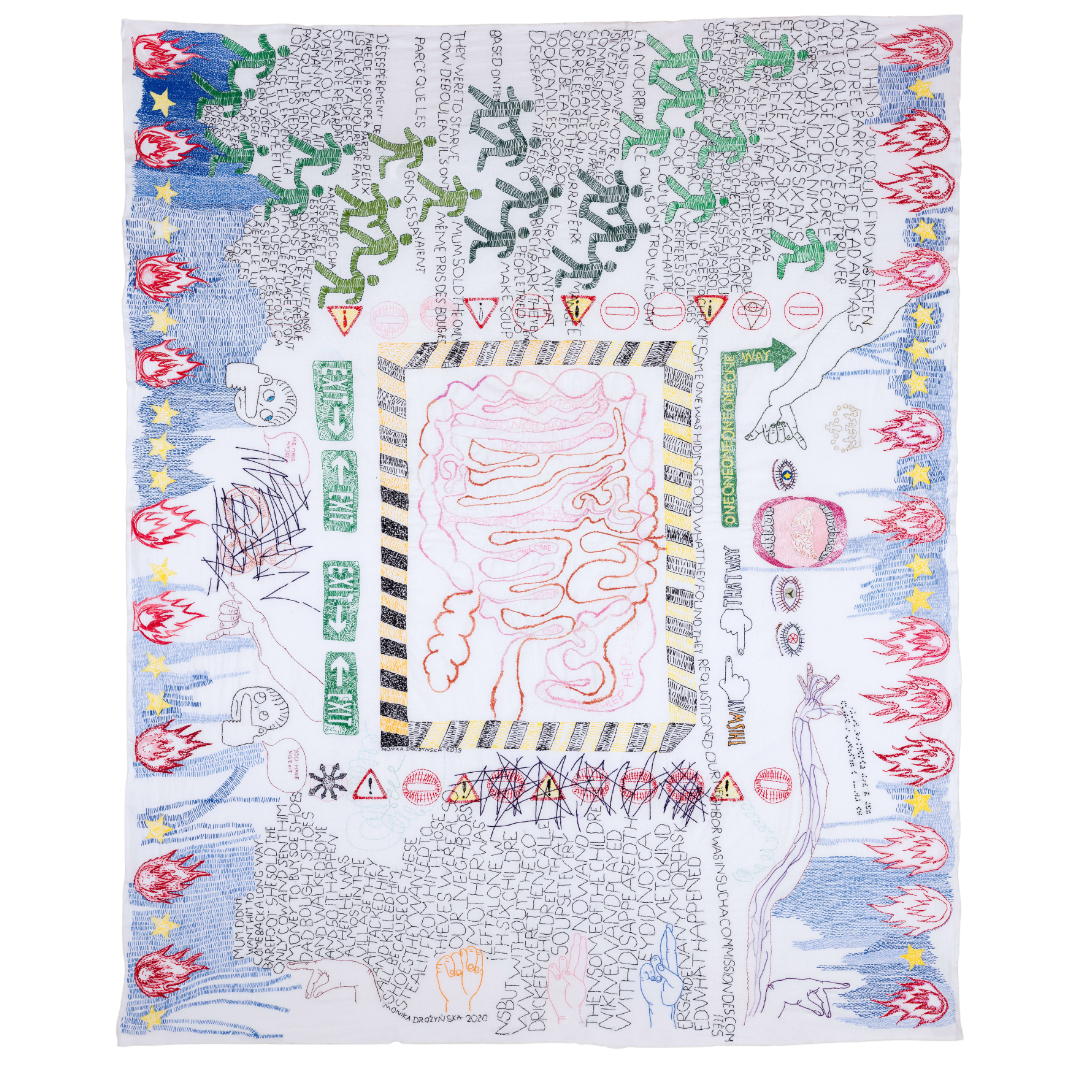
Hand embroidery on cotton fabric
2019
160 x 220 cm, photo: Mateusz Torbus
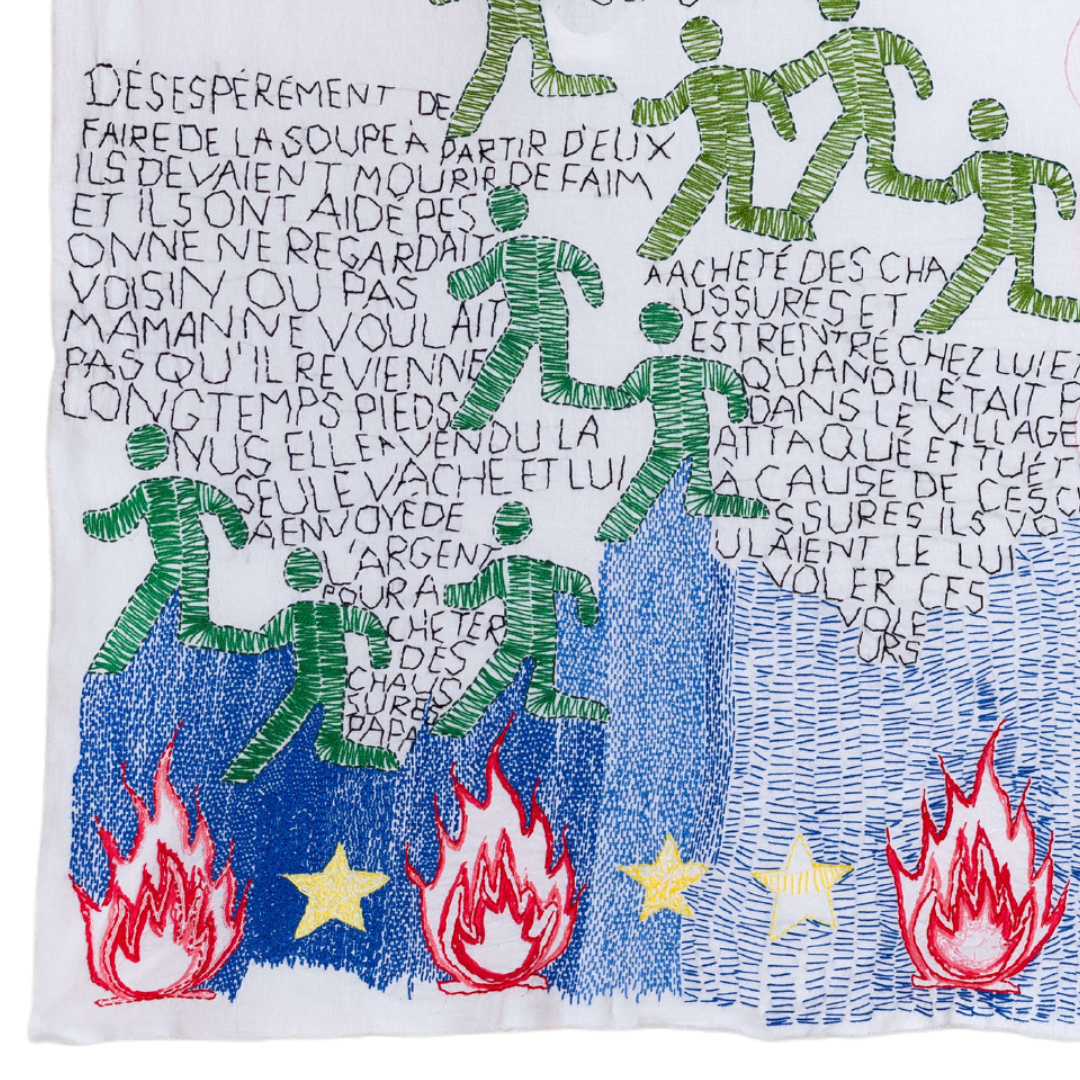
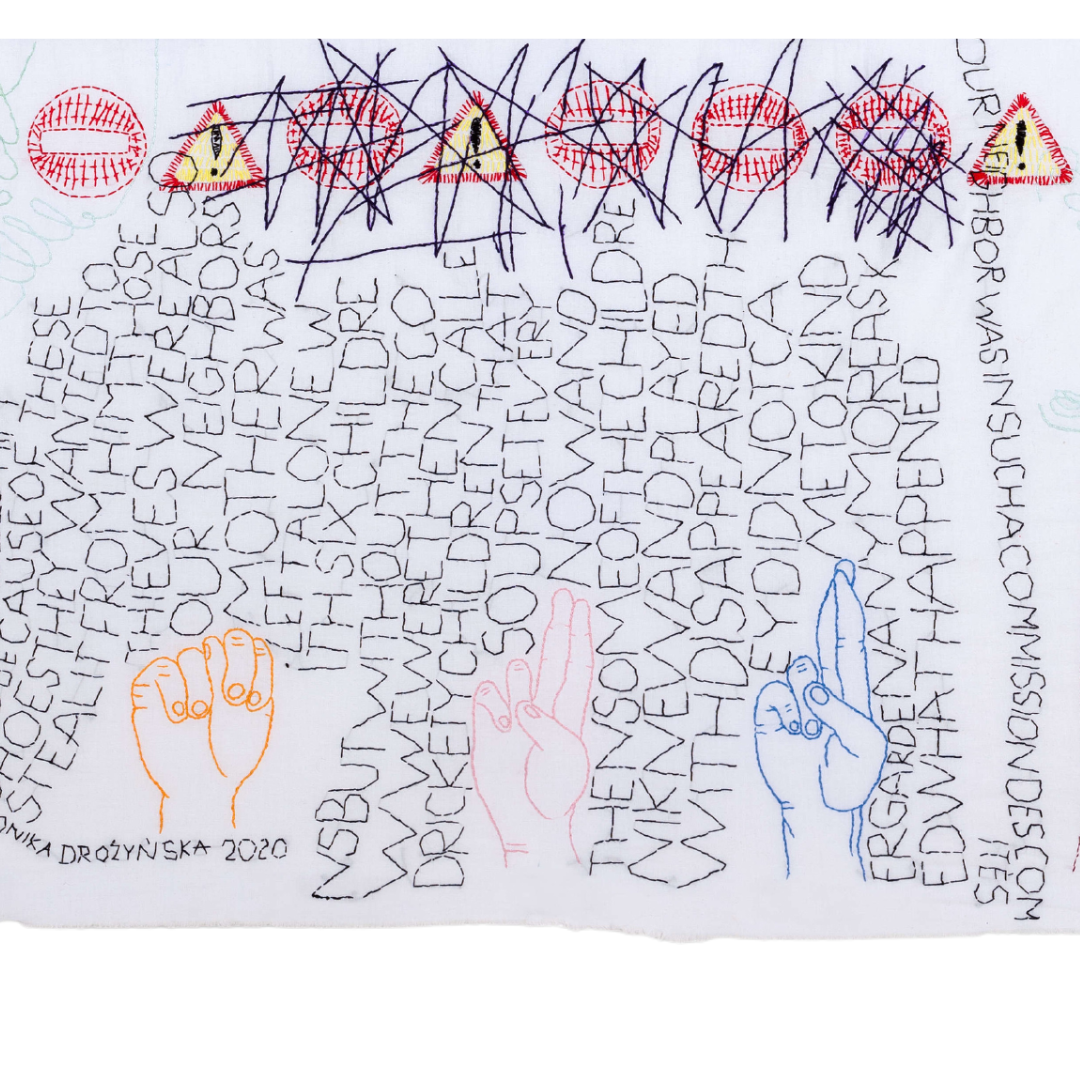
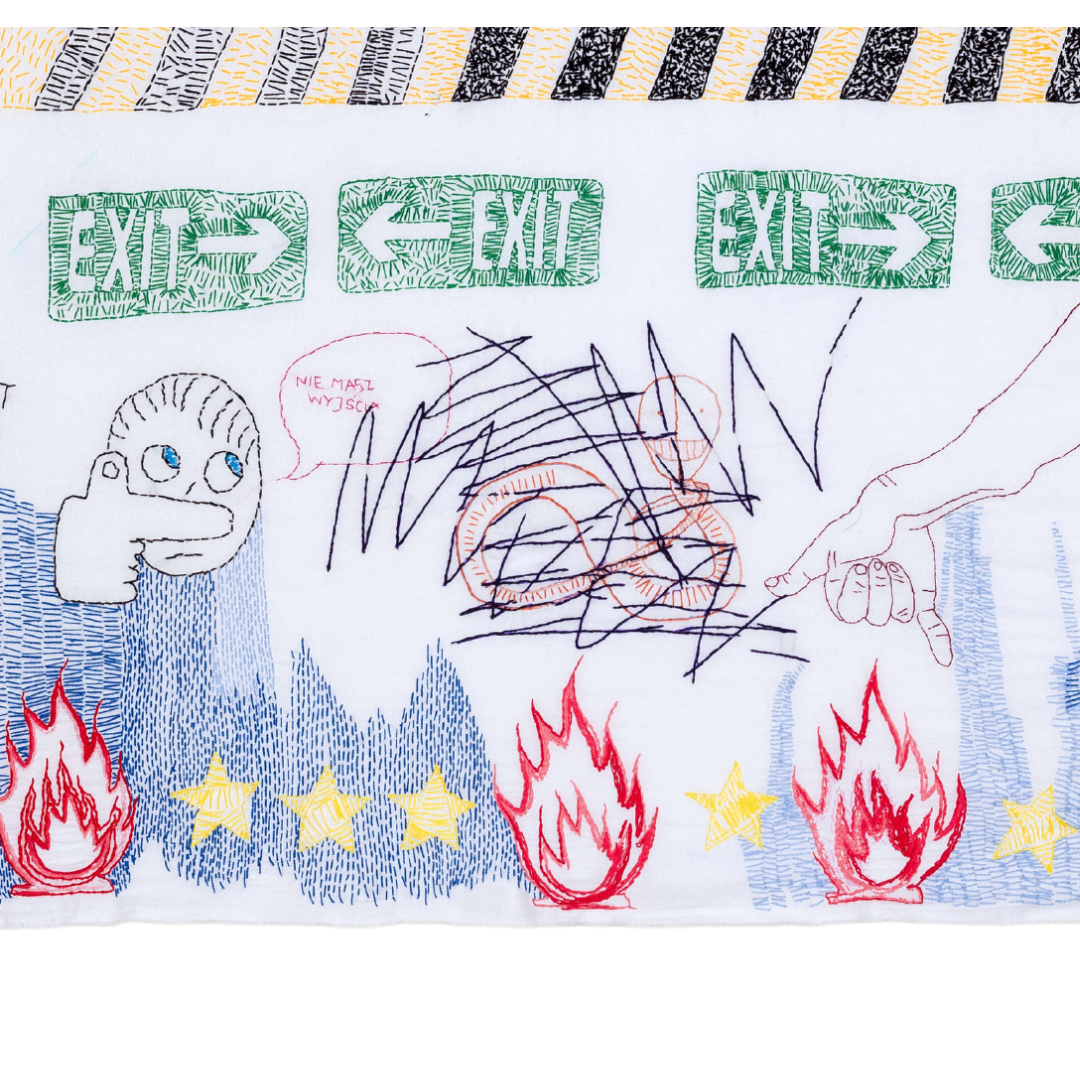
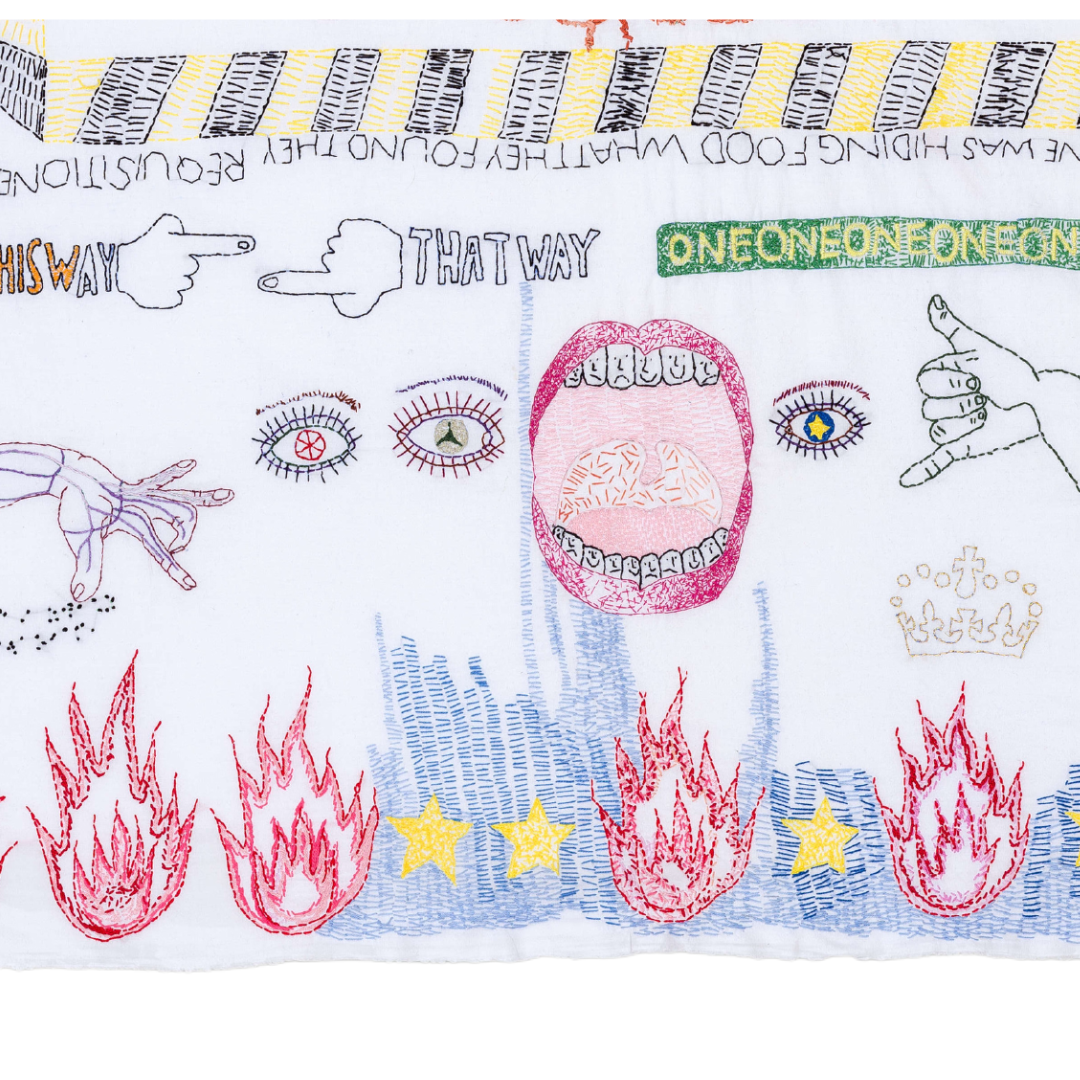
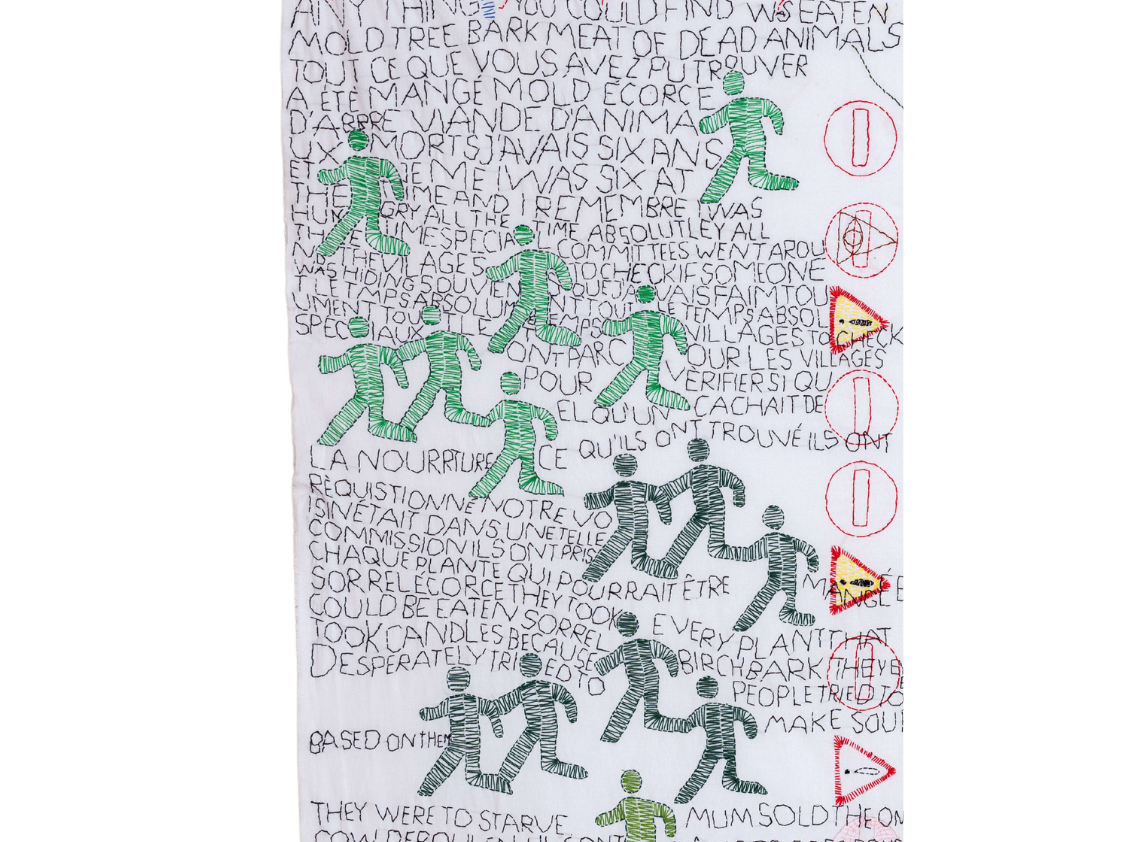
Work from the series Tablecloths. On the fabric, the artist writes the story of 91-year-old Hanna Basaraba, who is one of the last living witnesses of the Great Famine in Ukraine. In 1933, Stalin starved five million people, maybe more. Every seven seconds, someone died of starvation in the Ukrainian countryside. Her story was heard to and transcribed by Witold Szabłowski. Drożyńska then transcribed the English translation of the story onto fabric using hand embroidery, so that – just as the storyteller wanted – we would all know and remember:
“One ate whatever one could find. The mold. The bark of trees. The meat of dead animals. I was six years old at the time, and I remember that all the time, absolutely all the time, I was hungry. Special committees went around the villages then, in 1933, to check if anyone was hiding food. What they found – they requisitioned. Our neighbor was on such a committee, they took every plant that could be eaten. Sorrel. Birch bark. They even took candles, because people in desperation tried to make soup based on them. Stalin told them to starve Ukraine, and they helped in this; no one looked, neighbor or not. Moments before the Great Famine, my father went to work at the kolkhoz. Someone there made a mistake, they gave the foal too much food, and it died. They accused my father that it was because of him and put him in jail for several months. For sabotage. When he was about to leave, mother didn’t want him to walk back such a long way barefoot. She sold the only cow and sent him money to buy shoes. Dad bought the shoes and set off home on foot. And so it happened that when he was almost in the village, they attacked him in the Boretsky forest, here near my village of Rostovka, and killed him. All because of those shoes. They wanted to steal them from him. Those thieves, by the way, were also our neighbors. And for that most difficult year, 1933, and for that most difficult winter, when so many people died of starvation, my mother was left alone with six children, and without a cow. In the whole village then people’s children were dying. And somehow it so happened that our mother did not die a single one. We all managed to survive. I don’t know if there was another such family in the village. I was lucky, because I went to kindergarten and there they always gave such a thin soup to eat once a day. But despite this soup I was so swollen that I couldn’t walk. All the children were swollen. Thin legs, thin arms, and on top of that, big bellies. At that time we were called “rachitic children”. That they were so sickly. Every now and then, one of the children I knew and played with would disappear. He no longer came to the kindergarten. No one asked what happened. There was no point in asking. It was clear.”
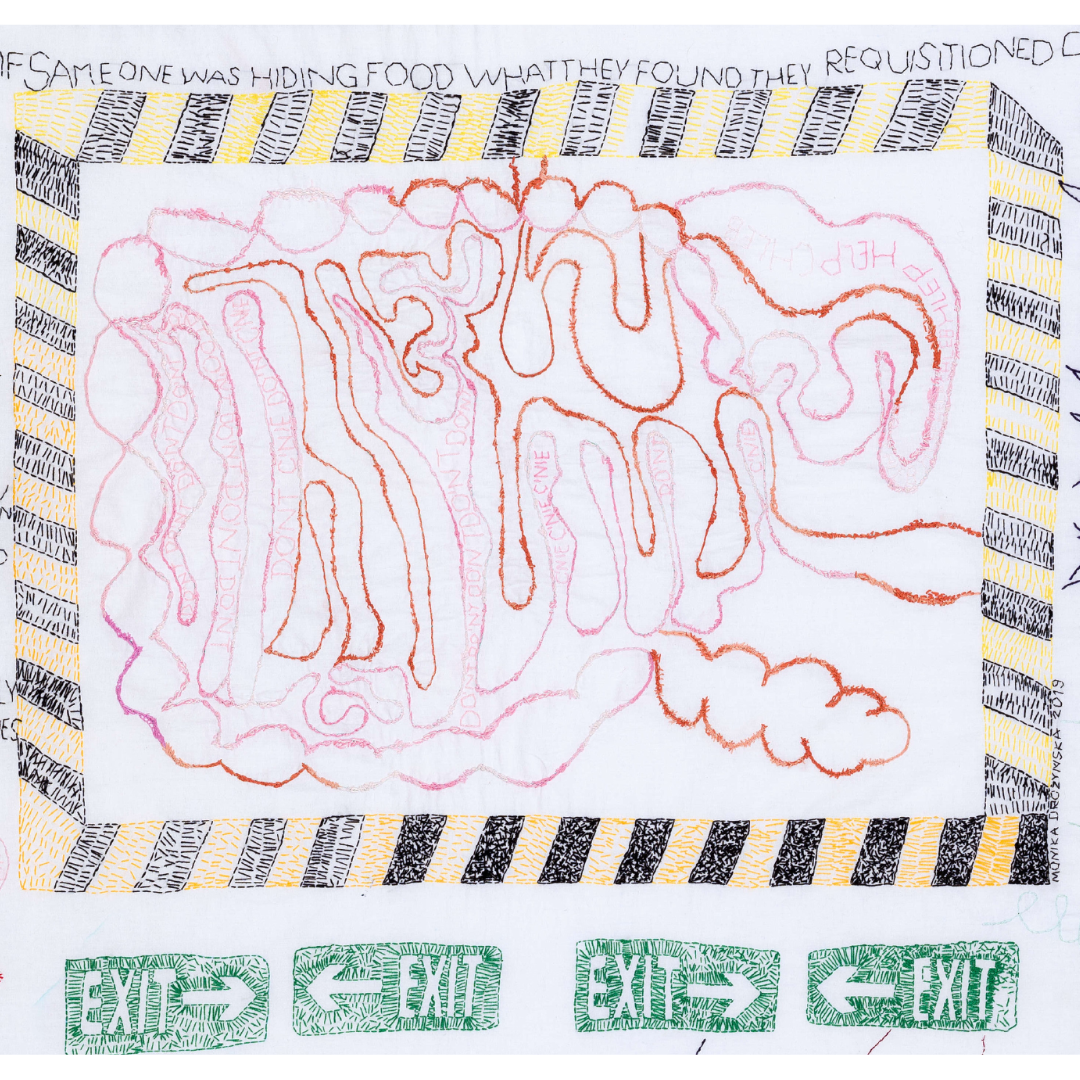
“The hungry become refugees” [1]. Needs cause migration. Physical hunger, hunger as an impulse to satisfy the need for fulfilment, for a better life, prompts people to leave. To go, to drive, to move. The centre of the fabric is the intestines. The end of the digestive tract, referred to as “the second brain.” Ninety per cent of signals travel from the gut to the brain [2]. If one observes depressive or anxious states or symptoms of high stress, one may suspect that the cause is not in the head, but precisely in the gut [3]. The quality of nutrition influences which signals are transmitted to the brain and, consequently, the quality of life. In the intestines, the process of peristalsis takes place [4], a movement synonymous with the movement of food from the gastrointestinal tract to the rectum, a process analogous to migration.
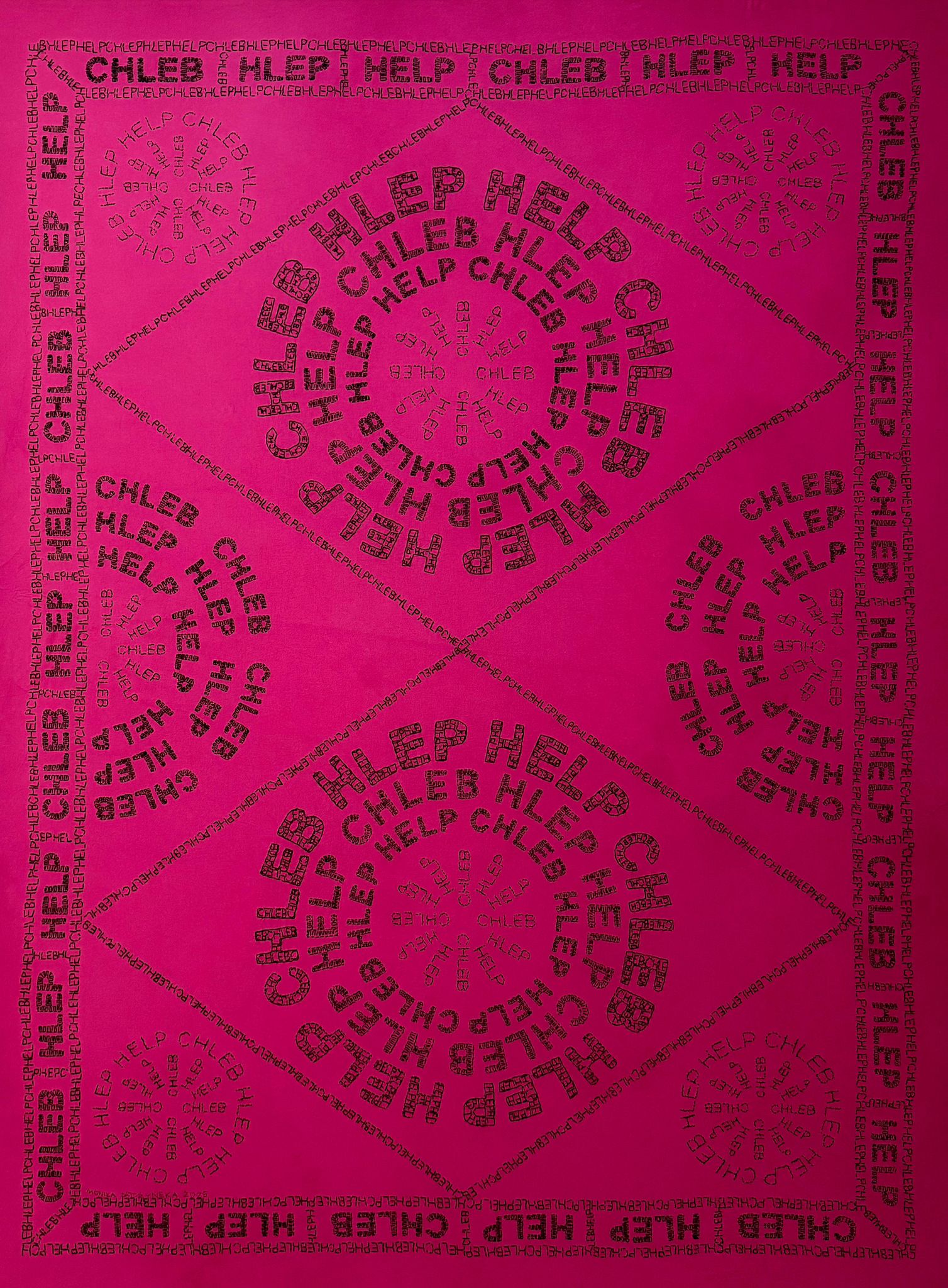
In the intestines, I wrote: chleb*/hlep/help. This phrase refers to Saussure’s theory of langue à parole [5]. The subsequent words in this phrase are derived from the preceding words: chleb has been embroidered correctly, hlep is chleb written phonetically, and help is hlep written with a typo (or an anagram), as well as a word in English. A space of meaning – a geographical space – appears between the three words. The relationship between Ukraine, Poland, and the UK, between economic migrants and indigenous people.
*chleb in Polish means bread, hlep is chleb written phonetically,
[1] Martín Caparrós, Hunger: The Oldest Problem, Melville House, 2020, p. 22
[2] See: “Jelita to nasz drugi mózg” [The gut is our second brain], available at: https://pulsmedycyny.pl/jelita-to-n asz-drugi-mozg-885479 accessed 22.05.2020
[3] ibid
[4] ibid
[5] https://en.wikipedia.org/wiki/Peristalsis