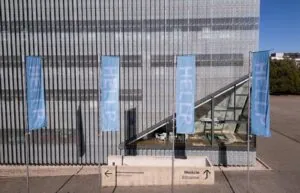
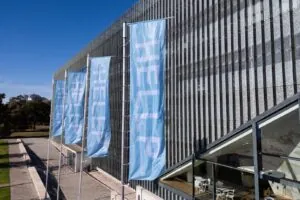
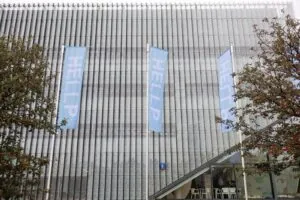
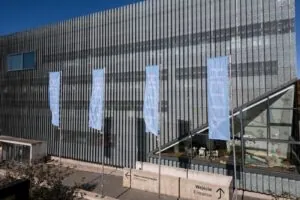
Hellp
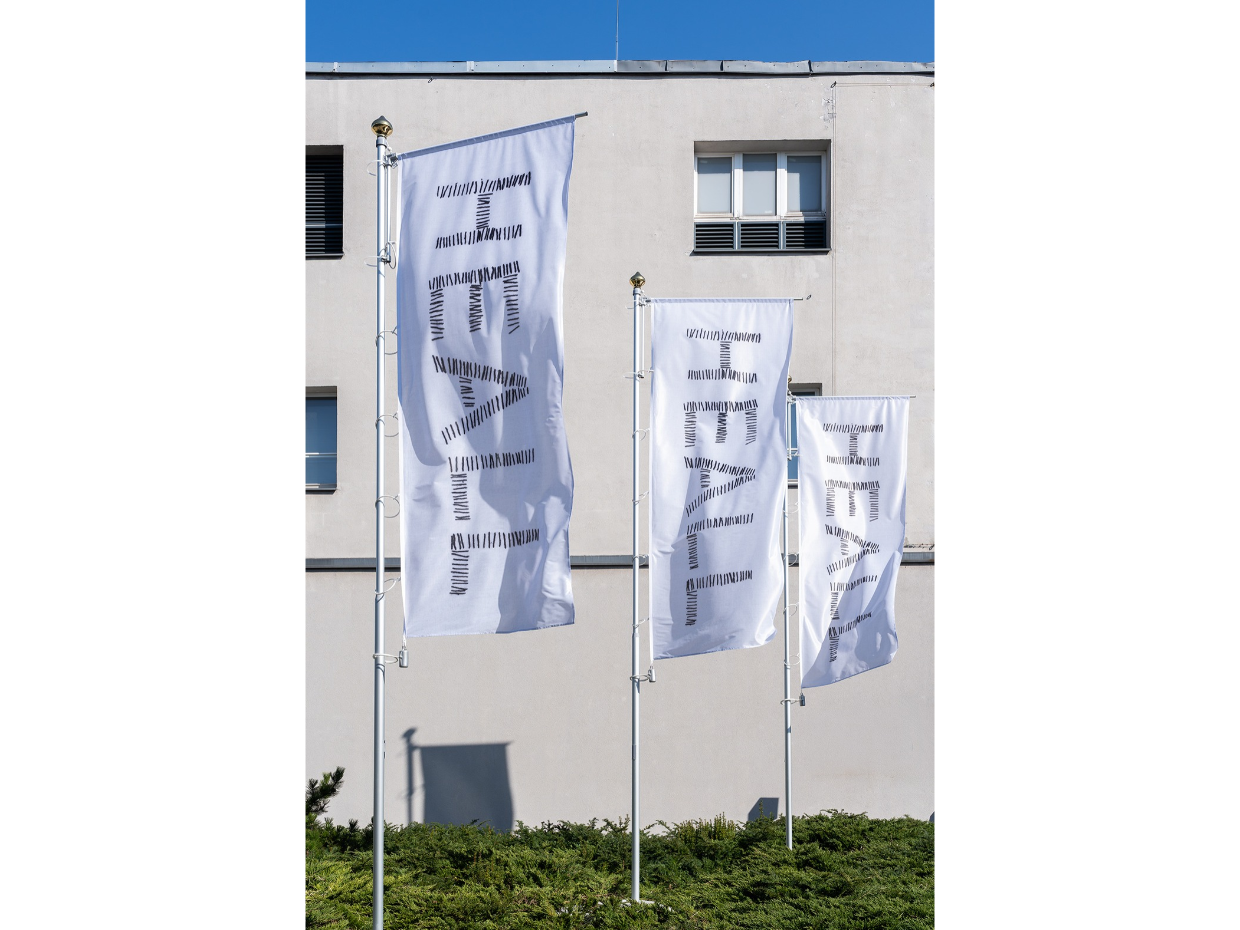
fabric, installation in a public space
2025
Dimensions: 1.5 x 6 m
“HELLP” is a work about situations in which the roles of victim and perpetrator cease to be clear and begin to blur. I’m interested in the moment when violence is not a one-time event, but something that repeats itself, loops, and leaves a mark on the collective memory. This is a story not so much about a single act of violence as about the systems that produce and perpetuate it—even when they speak of neutrality, care, or mediation.
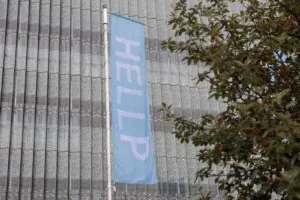
Visually, the work draws on the language familiar from humanitarian institutions and international orders. Blue and white are associated with peace, safety, and aid; they evoke the aesthetics of the UN, blue helmets, and aid organizations. On the one hand, they promise protection and reconciliation; on the other, they raise questions about the limits of that protection. When does aid truly protect, and when does it become merely a means of managing conflict and its public image?
The word “HELLP” deliberately combines “help” and “hell.” It is both a cry for help and a description of the state from which that cry emerges. Against the blue background, the white lettering functions as a simple warning sign. Here, the language of aid clashes with the experience of catastrophe, as if aid always arrived too late or were inextricably intertwined with the hell it attempts to name.
This work addresses a world of perpetual crisis, in which dozens of armed conflicts are raging simultaneously, with civilians and refugees bearing the brunt of the suffering. War brings enormous profits to the arms industry, politicians, armies, reconstruction companies, and speculators. Ordinary people bear the costs, losing their homes, security, and future.
For me, the current political situation in Gaza and the genocide taking place there also provide a very important context for “HELLP.” The work emerged from a sense of powerlessness in the face of the scale of violence, civilian deaths, and the systematic destruction of life unfolding before the eyes of the world. At the same time, the language of aid, protection, and humanitarian action continues to be used. It is here that the tension between aid and hell becomes most apparent. Declarations of support and neutrality coexist alongside real hunger, bombings, and mass death—all of which go unchecked.
“HELLP” thus addresses the ambiguity of humanitarian rhetoric and can be read as a critique of the aid industry, which is sometimes not only a response to suffering but also part of the mechanism that perpetuates it. Aid becomes a political tool, a bargaining chip, and a means of image management, while human suffering fades into the background of official narratives.
The display of the flag on the flagpole in front of the POLIN Museum further reinforces this meaning. In a space marked by a history of violence, exclusion, and the Holocaust, the work functions as a universal warning sign. It places the viewer in the uncomfortable role of a witness and poses simple yet difficult questions: Whose voice do we hear when someone cries out for help? And are we capable of responding while taking responsibility for the consequences of our own actions or inactions?
“HELLP” is thus a visual metaphor for a state of emergency. It is a work about a world that simultaneously needs help and becomes a hell in itself, and about language that attempts to tame this tension, though it is never neutral or innocent.
photos by Maciek Jazwiecki, courtesy of the Polin Museum